Skip to my Shoppe

Grab a Handmade Gift Guide Button here

Grab a Handmade Gift Guide Button here

Yes, you can make it!

Save data...

Posts Tagged ‘kid’s crafts and activities’

Halloween Votives

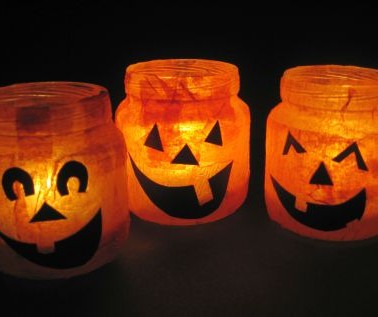
Here is another simple (but messy) Halloween Craft!  You need just a few supplies.  My Mod Podge has gone bad I think, so we used it along with Elmer's Glue (My daughter sorta mixed it together---she is 3 so this wasn't exact science).  I think Mod Podge alone would have been fine.  We were using items we had so we used orange crepe paper on a roll for the pumpkins and white tissue paper like you use to wrap a gift for the ghosts.

My daughter coated the outside of the baby food jar with glue/Mod Podge.

She then took pieces of crepe paper and put it on the jar. We gave the whole thing another coat of mod podge. It is important to dab gently so you don't tear and wipe the crepe paper away.

We  made faces with scraps of black construction paper and then waited for them to dry.

Once they were dry I thought they probably could have used another coat of Mod Podge, however that could be because mine was old.  I didn't want to get it back out so I just gave them a shot of clear spray paint.

It is starting to look a lot like Halloween around here!

You might also like:

Paper Ghost Garlands

How to "BOO" your friends

Halloween Games

How to make a pop-up pumpkin card

Thanks for taking the time to visit me today!

Bloggy Book and Craft-a-thon Day 7

I am privileged to introduce you to today's guest blogger, Alicia.  Yes, she is as warm and sweet as her blog, Mayfly.  Alicia has a special eye for photography.  Her photos make you stop, pause and really notice. I always feel that Alicia has found the trick to getting every drop of enjoyment out of each day! I hope you will stop by and see her beautiful murals, darling dolls and tons of creativeness!

- - - - - - - - - - - - - - - - - - - - - - - - - - - - - - - - - - - - - - - - - - - - - - - - - - - - -

Alicia writes...

When my son was born, my husband’s very cool cousin Chuck sent a very cool gift: Where the Wild Things Are, written and illustrated by Maurice Sendak. It’s one of those books that you loved yourself as a child and thought you had outgrown, but now that you look again you realize you haven’t. It is full of spirit and imagination and beautiful artwork. I’m betting you all know this book as well as we do.


So when Cindy asked me to guest post here, I had to do something Wild Thing related. We decided to
make our own Wild Guys. They turned out pretty cute and were super easy! These little creatures are
essentially just pillows. So for you sewers, there you go. Have fun! But for those of you who aren’t, here are the steps to take:
Draw your creature. We used used fabric markers (fabric crayons or fabric paint would work too), so I cut each kid two pieces of white cotton from a thrifted cotton sheet- one for the front and one for the backing. Tape down the edges so the fabric stays tight.

I told them that they could use the whole piece of fabric, but that they needed to leave some little space all the way around for the stitching. Then they drew their guys. J wanted to use the book for inspiration, N wanted to create her Wild Guy from scratch. Next follow the directions on the markers to heat set the ink.

Now cut around the guys with about a 1” border for stitching. (We didn’t decorate the guy’s backside, but you surely could. Just be sure to do it before you stitch, so the markers don’t bleed through to the front.) Turn the drawing right side down against the backing fabric, pin and stitch around the critter leaving a space for turning and stuffing. I used my machine, but you could easily sew these by hand. An older child could even do this step him/herself. Trim to about 1/4” from your seam.

Next turn the Wild Guy right side out and stuff him full. My kids loved this step. We used polyfill so they will be washable. Hand stitch the opening closed and you’re ready for business!

You could do this with any book really, making existing characters or adding new ones for reenactments, inventing sequels, or just for snuggling.

Enjoy!

Oh, and one more thing. There is nothing sweeter in the world than seeing your older child reading to the younger one. Nothing. If you haven’t experienced this yet with your kids, just wait. You’ll melt into a puddle- you’ll see.
Thank you, Cindy, for including me here and for your efforts encouraging the love of reading and raising
awareness for the Read to Feed program- such an incredibly worthwhile cause.

You might also be interested in:

Making Creatures with Fabric Crayons

Bloggy Book and Craft-a-thon Day 3

Lauren and Derek of the Curiosity Shoppe are guest posting today to help promote the Read to Feed Project! Everything you will find at their shop in San Fransisco is special. They have taken great care to fill their shop with items and ideas that will delight, amuse and inspire.  You will also find them each Wednesday at Design Sponge sharing creative and useful projects. Be sure to check them out! They will amaze you with their creativity!

- - - - - - - - - - - - - - - - - - - - - - - - - - - - - - - - - - - - - - - - - - - - - - - - -

Lauren and Derek write...

These bright and colorful tissue paper flowers are inspired  by the book Ferdinand, by Munro Leaf.

We love the book Ferdinand for its beautiful illustrations and wonderful story about a bull who would rather sit under a tree and smell the flowers than charge the bullfighter who is taunting him at the opposite end of the ring.

How to make Paper flowers inspired by the book Ferdinand, by Munro Leaf

Ingredients:

Colored tissue paper

Scissors

Floral wire

Floral tape

How-to:

1. For each flower you will need 3-4 squares of colored tissue paper, measuring about 5" square. Stack up the paper and fold into quarters.

2. Cut a rounded edge with your scissors, adding little wavy scallops as you cut.

3. Bend the top of one of your pieces of floral wire into a loop and thread the opposite end through the center of your stack of tissue, pushing it all the way up the floral wire until it catches on the loop.

4. Wind a 4" piece of floral wire around the base of the flower, making sure to catch a bit of the paper and continuing down the stem 1"-2".

5. Gently separate the layers of tissue paper and crinkle them slightly to create the petals and give the flower some volume.

Derek Fagerstrom and Lauren Smith are the owners of the Curiosity Shoppe in San Francisco and are the DIY editors at the popular design blog, design*sponge.

- - - - - - - - - - - - - - - - - - - - - - - - - - - - - - - - - - - - - - - - - - - - - - - - - - -

Who loves flowers as much as Ferdinand? -- Bees!

From India to the Dominican Republic, bees from Heifer International help struggling families earn income through the sale of honey, beeswax and pollen.

Beehives require almost no space, and once established, are inexpensive to maintain. As bees search for nectar, they pollinate plants. Placed strategically, beehives can as much as double some fruit and vegetable yields. In this way, a beehive can be a boon to a whole village.

Although most Heifer partners keep bees as a supplement to family income, beekeeping can be a family's livelihood. Your gift provides a family with a package of bees, the box and hive, and training in beekeeping.

Making Doughnuts

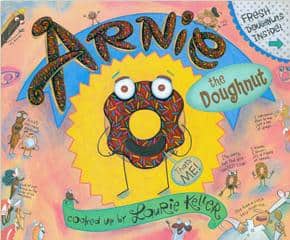
Today we were busy baking and making. With Arnie the Doughnut by Laurie Keller as our inspiration we filled our tummies with yummy doughnuts.

We used 101 Cookbook's recipe for baked doughnuts. They were (yes we ate the whole 1 1/2 dozen YIKES) delicious. I would like to believe they were healthy since they were baked---but they were dipped in butter and rolled in cinnamon sugar. We were able to make the entire recipe in the food processor. This makes quick time of the kneading (we counted to 45 slowly and it was done).

And so you don't think we are only about weapons around here, we made felt doughnuts too. My eleven year old was amazing with his needle and his sister was thrilled to have some new play food.

First we cut out our felt circles. You may use our template if you like.

doughnut-template

Sew the frosting to one of the doughnut pieces.

My son then sewed "sprinkles" all over the "frosting" with embroidery thread.

With right sides together sew doughnut pieces together, leaving an opening for turning

Turn doughnut right side out.

Stitch completely around the center of the doughnut. We found this easiest to do on the sewing machine. Stay as close to the edge as possible, catching the top and bottom layers.

Stuff doughnut and slip stitch dounut closed!

Ta Da!

We hope you will consider reading along with us to Reed to Feed! This funny and superfluous story gave me pause. As we are reading and eating I am reminded of how lucky we are to have an abundance of food. We can "play" with our food. This it not the case for so many. As a world population over 800 million people will go hungry today.

Marbleizing Paper

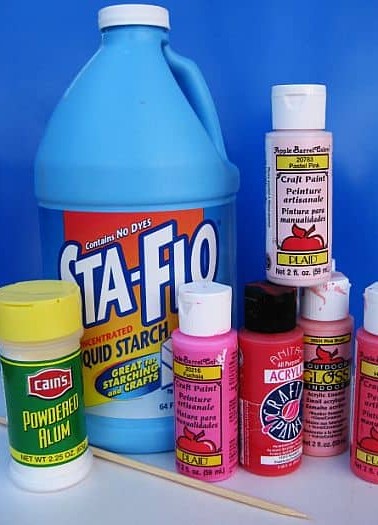
To make this fun and easy marbleized paper you will need: 1/2 tsp alum (helps paint adhere to the paper), 2 cups liquid starch, liquid acrylic paints, a long wooden skewer , a 9 X 13 pan and white copy paper cut to fit the inside your pan. You can change up the size of the pan, just keep the proportions of starch and alum the same. The starch should be 1 to 2 inches deep in your pan.

marbelizing-paper-006-1.jpg

Pour 2 cups of liquid starch in the pan then add 1/2 tsp alum stirring until mixed.

marbelizing-paper-002-2.jpg

Gently drop acrylic paint on the surface of the starch. Some paint will sink to the bottom- do not worry. Try not to use too much paint. For best results choose light and dark colors that go together. It will take some experimenting to know how much paint works best for you. Brands of acrylic paint differ in consistency. If after several tries you have trouble with the paint not staying on the surface, try adding a drop of water to your paint.

marbelizing-paper-001-3.jpg

Take the wooden skewer and drag the paint through the starch. Continue dragging the skewer through the paint until you get a design you like. You might try other tools like a fork, feather or comb besides the skewer. Really the fun of this activity is watching the paint swirl around making different designs. There is no right and wrong. Enjoy the experimenting. We were mesmerized ---- we hope you will be also!

marbelizing-paper-003-5.jpg

Lay your piece of paper on top of the starch. Allow it to sit for a couple of seconds.

marbelizing-paper-005-4.jpg

Lift the paper out of the pan and allow the starch to drip off the paper

marbelizing-paper-004-6.jpg

Rinse the paper under running water removing any extra starch. This does not change the intensity of the colors (the below photo is a different piece of paper paper from the above photo)

marbelizing-paper-010-7.jpg

After the paper has been rinsed, lay it out to dry. It will take about two hours for the paper to dry. When the paper is completely dry, iron on medium setting until the sheets of paper are flat.

You may find that you can print two sheets of paper before adding more paint to the starch. In the photo below, the bottom piece of paper was made first. We then used our skewer again making a different design and put on another sheet of paper.

marbelizing-paper-007-8.jpg

In the photo below we had too much paint on our starch so we went ahead and made a print then changed up the design and then made another. If you feel that you have made a lot of prints and your starch is too full of paint, just pour it out and start again.

marbelizing-paper-001-9.jpg

The possibilities of what to do with your paper are endless---- cover pencils, a book or a box, make note-cards, book marks or a picture frame etc.

Have fun!

Max Moms

© 2009 Skip To My Lou
LinkWithin Related Stories Widget for Blogs